


Back to Board Index
Back to Board Index
Forum help
| The VFR Circuit | |
Matthew Harris  5th Nov 2010 11:18:44 | Hay my fellow simmers,
I am suffering from a bad case of tonsillitis (booo) and as such am off work. I am bored out of my tree and waiting for VFR scenery to install so I thought I would put my time to good use and write a very breif overview of the visual circuit. Last night was VFR flying at Shoreham, for those of you who attended im sure you will agree it was excellent. It was my first time taking part in VFR at Shoreham and what stuck me was the realism. About 2-3 years ago I got my PPL but havent flown since, so yesterday was a great "refresher" session for me. For those of you who are new to the world of VRF and circuit flying, it can be overwhelming but like everything in aviation, there is a logical and easy to understand process behind the apparent madness. Ok, i guess the obvious place to start is... What is the circuit and why do we need one? The circuit is a very simple framework used to enter and leave an airfield. Sometimes referred to as "the pattern" and I guess it is exactly that (albeit not a very exciting pattern). It is a structured approach to organising aircraft coming in and going out of the airfield. If we didn't give some structure to the departure and arrival into the airfield, we would have aircraft bumbling all over the place and accidents would be inevitable. We give structure and names to various parts of the circuit so that pilot know where to look for other aircraft. For example, If I call "downwind" everyone else in the circuit knows to look for me downwind. If they can see me there is less chance they will hit me. It really is a win win. Ok so we know now why we used circuits. Lets take a look at one. As you can see below the circuit is split up into sections. Again this is to keep it simple and organised, we give names to the sections so we can easily identify where everyone is. 
So this is a full picture of the circuit, it is broken down into 4 parts. Circuits can be flown between 500 - 1500 ft AGL (Above Ground Level). The controller can relay this information so dont worry about it :-) . We will fly our circuit at 1100ft. We will take off from runway 27 and do a LEFT HAND circuit (meaning all our turns will be to the left....shimples ;-) ) Upwind/Departure 
*please note, I am assuming you know how to take off* So you take off and start climbing away. The climb will often be steeper than a straight out climb this is because we want to keep a nose high attitude as to not gain too much speed. The circuit is not a race and if you treat it like one you will get yourself in trouble. So we climb away in an 80kt climb, we dont mess with the power setting to keep 80kts we change our Attitude. We are flying a 1100ft circuit so at 600ft we will start a climbing turn 90* onto our crosswind leg Crosswind 
Crosswind means exactly that, we are no longer flying into wind we are flying "crosswind" wow I told you this was simple. So the only thing you need to remember about cross wind is that it is 90* from direction of runway. So if we took off on runway 27 (thats 270*) after making out 90* crossing turn we will be facing 180* or SOUTH. The main event which happens during crosswind is we reach our circuit high of 1100ft AGL. When we reach 1100ft we need to level out to stop the climb, but we also need to bring our throttle back so we dont speed up. Normally reducing throttle setting to 2100RPM will suffice, but depending on the conditions you might need to add a smidge remove a smidge (and yes smidge is an offical technical aviation term ;-) . Ok So we are levelled off at 1100 and flying our crosswind leg. Our next turn will be 90* to the left onto our downwind leg. Downwind: 
Ok so no prizes for guess why this is called the Downwind. The wind which was blowing from 270 is now blowing from behind us blowing us down the runway. Ok so we turned 90* and we are now facing EAST, we are flying parallel to the runway. We must make sure we are parallel and flying the exact reciprocal of the runway heading. Regardless as to what angle we made our turns onto cross wind and downwind, we must always be flying parallel to the runway , on the opposite heading. So if the runway in use is 360 , on downwind we will be flying 180. We always report to ATC when we are downwind, letting them and other aircraft know our position. Now the next turn we make is a turn onto our BASE leg. This turn is again 90* to the left, however you are going to need to judge when to make the turn. The rule of thumb is to start your turn onto base when you are 45* from the runway threshold . Runway threshold is the chunky white lines running down the runway at the beginning of the strip. Sometimes refereed too as the "piano keys". At night the threshold is marked by a line of green lights 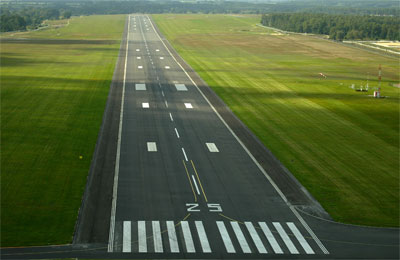
So we are still flying downwind , parallel to the runway. We want to start our turn onto base when we can see the threshold over our left shoulder and if we drew a line from the threshold to us, that line would be approximately 45* So we are 45* from the threshold and ready to make our 90* turn onto base. Base: 
Base leg is the beginning of our decent we need to do 2 things. We need to do our landing check-list which configures the aircraft for our approach and landing, and we need to start our decent back to the runway. Landing check-lists can be found by pressing shit+F10. In the cessna they are are follows: Seatbelts and Harness ......................... Fastened and adjusted Landing Lights ................................ ON Fuel Selector.................................. ON Mixture........................................ Full Rich Carburetor Head................................ ON Flaps.......................................... As Required Checklists will vary depending on which A/C type your in, so check. If you have retractable gear, you will need to lower it during your landing checklists. As for the flaps, you want to lower them in stages. On your airspeed indicator is a white arc , this arc indicated the speed range for flaps, if you lower flaps while outside of this white arc you risk damaging them. If you dont take flaps while in the white arc you risk stalling. So our base leg we will bring our speed back to 75Kts and apply our first stage of flaps. We will reduce our power wait for our airspeed to decay to 75kts and start our decent. Our 4th and final turn is our turn onto Finals. Finals: 
Ok so, again we make a 90* turn, this time we turn to line up on the centerline of the runway. We want to aim to make this turn at 600ft AGL. The accuracy of this depends on how well we managed our decent during base. So we are now flying towards the runway and descending. We need all our concentration now to make sure we have a good landing, that's part of the reason we do all our landing checks during base. The only checks we do on our finals is take our final stage of flaps if we have them and reduce our speed to 65kts and we say "breaks clear" to make sure we are not resting our feet on our foot breaks. Now until now we have been flying using attitude to control speed and power to control height. Finals is the only time we break this rule. We now need to use our throttle to keep our speed and our attitude to control our rate of decent. We need to focus now on the runway and keep a good "picture" out of the window.  TOO HIGH TOO HIGH
 TOO LOW TOO LOW
 CORRECT!! CORRECT!!
Ok so we use our attitude (yoke/joystick) to keep this picture and we use our throttle to maintain our approach speed of 65kts for the cessna. We follow this all the way in, close the throttle as we fly over the numbers, flare and touch down. If we are touch and go we will raise our flaps to T/O , realign with the centerline and apply full power to start the whole thing again. If we are Full Stop, we will vacate the runway. And thats the circuit! Ok, My VFR scenery finished installing ages ago so I am going to stop writing now. I learned to fly with the RAF and the circuit procedure was slightly different to that of the PPL so I apologise if I've made any mistakes. Hope this helps for any new guys wanting to understand the Circuit better. The best way to learn is to just come online and have a go, the guys on FSopen are always more than happy to help and if you dont know something just ask! :-) Cheers guys, time for another lemsip |
Laurence Woodside   5th Nov 2010 11:47:28 | Great explanation Matthew very informative. "Smidge" I never knew that! Must add it to my ATC speak!
L |
| Mick McG 5th Nov 2010 19:59:21 | Matt, if you produce work as good as this for FSO when you're poorly I hesitate to say "get well soon"! This is a really useful guide, nice work mate.
M |
| Christian Smith 5th Jan 2011 16:40:01 | Possible add for the pilot section? |
You need to Log on to post a reply. |
Forum help